
Introducing Eyerising in a healthcare facility.

A path for doctors, optometrists, orthoptists and people responsible for organizing the facility's work.

Get the implementation pack

Scientific research on RLRL

Low-intensity repeated red light therapy – RLRL (Repeated Low-Level Red-Light) – is the subject of research conducted by various research teams. Below we present selected, verified publications regarding effectiveness, safety, response to therapy and control of myopia progression.

Bibliographic verification: PubMed and DOI, 15/09/2026. The summary is neither a systematic review of all publications nor a clinical recommendation.

Clinical effectiveness

Effect of Repeated Low-Level Red-Light Therapy for Myopia Control in Children: A Multicenter Randomized Controlled Trial.

Ophthalmology · 2022 · Multicenter, randomized, parallel, single-blind clinical trial

Authors: Yu Jiang; Zhuoting Zhu; Xingping Tan; Xiangbin Kong; Hui Zhong; Jian Zhang; Ruilin Xiong; Yixiong Yuan; Junwen Zeng; Ian G Morgan; Mingguang He

What was tested: The change in eye axial length and refraction with RLRL was compared with standard single vision glasses.

Details of the study
Population
264 eligible Chinese children aged 8–13 years; 246 children were included in the analysis.
Methodology
RLRL with single vision glasses was compared with glasses alone; observation lasted 12 months.
The most important result
In the analysis, the authors reported less axial elongation and less refractive progression in the RLRL group than in the control group.
Safety
There were no serious adverse events, functional visual loss, or structural changes in OCT during the follow-up period.
Constraints and context
The study was single-blind, focused on Chinese children and had one described system; observation lasted for a year.
Tested device/system
Tested system: Eyerising, Suzhou Xuanjia Optoelectronics Technology, 650 ± 10 nm. The publication describes a class IIa medical device according to China NMPA (registration no. 170808-01039) and, separately, optical exposure class 1 according to IEC 60825-1:2014.
The publication does not allow automatic identification of the tested device with the RS-200-1A model currently offered in Poland.
Funding and declared conflicts of interest
This study was supported by the Fundamental Research Funds of the State Key Laboratory of Ophthalmology and the National Natural Science Foundation of China (81420108008, 81271037). Zhuoting Zhu and Mingguang He have declared patent CN201910490186.6 related to the study.

Identifiers: Ophthalmology 2022; 129(5): 509–519. PMID 34863776.
Myopia Control Effect of Repeated Low-Level Red-Light Therapy in Chinese Children: A Randomized, Double-Blind, Controlled Clinical Trial.

Ophthalmology · 2023 · Randomized, double-blind, controlled clinical trial

Authors: Jing Dong; Zhuoting Zhu; Haifeng Xu; Mingguang He

What was tested: RLRL was evaluated against a sham device with 10% power of the active device.

Details of the study
Population
112 Chinese children aged 7–12 with myopia; 111 children were included in the analysis.
Methodology
Sessions lasted 3 minutes and took place twice daily, at least 4 hours apart; follow-up assessment was performed at 6 months.
The most important result
The authors reported less refractive progression and axial lengthening in the RLRL group than in the sham device group.
Safety
No treatment-related adverse events were reported in the abstract.
Constraints and context
The observation lasted 6 months and concerned one geographical population and the described RLRL system.
Tested device/system
Active and mock system tested: Eyerising, Suzhou Xuanjia Optoelectronics Technology; the sham device emitted 10% of the power of the active device.
The publication does not allow automatic identification of the tested device with the RS-200-1A model currently offered in Poland.
Funding and declared conflicts of interest
The study was supported by the Fundamental Research Funds of the State Key Laboratory of Ophthalmology (303060202400362) and Eyerising Ltd.; the sponsors had no involvement in the design or conduct of the study. Zhuoting Zhu declared patent CN201910490186.6, and Mingguang He declared board membership and ownership interest in Eyerising Ltd. and Eyerising International Pty Ltd. and this patent.

Identifiers: Ophthalmology 2023; 130(2): 198–204. PMID 36049646.

Durability of effect and rebound

Sustained and rebound effect of repeated low-level red-light therapy on myopia control: A 2-year post-trial follow-up study.

Clinical and Experimental Ophthalmology · 2022 · Two-year follow-up after completion of a previous randomized trial

Authors: Ruilin Xiong; Zhuoting Zhu; Yu Jiang; Xiangbin Kong; Jian Zhang; Wei Wang; Katerina Kiburg; Yixiong Yuan; Yanping Chen; Shiran Zhang; Meng Xuan; Junwen Zeng; Ian G Morgan; Mingguang He

What was tested: The continuation of the effect of RLRL and the change after discontinuation of use were assessed.

Details of the study
Population
Of 199 eligible Chinese children, 114 participants were included in the analysis; some continued RLRL and some ended them.
Methodology
Four groups were compared depending on the continuation or termination of RLRL and the use of single vision glasses.
The most important result
The authors reported the smallest two-year changes in AL and SER in the group continuing RLRL and minor rebound after completion.
Safety
There were no reported adverse events or functional or structural damage reported in the abstract.
Constraints and context
This is a post-study follow-up: participants were not randomly assigned to continue or terminate in the second year, and the percentage analyzed was limited.
Tested device/system
Tested system: Eyerising, Suzhou Xuanjia Optoelectronics Technology, home stationary device emitting red light 650 ± 10 nm.
The publication does not allow automatic identification of the tested device with the RS-200-1A model currently offered in Poland.
Funding and declared conflicts of interest
Not clearly established based on the available record.

Identifiers: Clinical and Experimental Ophthalmology 2022; 50(9): 1013–1024. PMID 36054314.

Treatment response and predictors

Effect of repeated Low-Level red light therapy on axial length in myopic individuals: predictors for a good response

BMC Ophthalmology · 2025 · Retrospective analysis of medical records and device records

Authors: Daohuan Kang; Lu Yuan; Jia Feng; Rui Yu; Andrzej Grzybowski; Kai Jin; Wen Sun

What was tested: Change in eye axial length over the course of 1 year and factors associated with good response to RLRL were assessed.

Details of the study
Population
91 participants were analyzed: 50 classified as poor responders and 41 as good responders; of the 157 individuals assessed, 66 were excluded according to publication criteria.
Methodology
The device's documentation and readings were analyzed from October 2022 to October 2023. RLRL was used for 3 minutes twice a day, 5 days a week, with a break of at least 4 hours.
The most important result
In the good response group, the mean AL change was −0.29 ± 0.16 mm, and in the poor response group, it was +0.23 ± 0.12 mm. Longer baseline AL and lower SER were predictors of good response; the relationship with regimen adherence had only a statistical trend.
Safety
The study was not designed as a comprehensive safety assessment. Exclusion criteria included an afterimage lasting more than 6 minutes or discomfort.
Constraints and context
Retrospective design, small sample size, exclusion of 66 of 157 individuals assessed, possible selection bias, lack of a parallel control group, and 1-year follow-up.
Tested device/system
Red light device from Suzhou Xuanjia Optoelectronics Technology, 650 ± 10 nm, about 1600 lx and 0.29 mW through a 4 mm pupil; class IIa product according to China NMPA and compliance with IEC 60825-1:2014.
The publication does not list the trade name of the therapy device or the model RS-200-1A; the name Eyerising in the text refers to the pupillometer used.
Funding and declared conflicts of interest
The study was funded by the Natural Science Foundation of China (82201195, 82201197). The authors declared no competing interests.

Identifiers: BMC Ophthalmology 2025; 25(1): 273. PMID 40335964.

Retina, microcirculation and choroid

Effects of repeated low-level red-light therapy on macular retinal thickness and microvascular system in children with myopia.

Photodiagnosis and Photodynamic Therapy · 2024 · Prospective imaging study

Authors: Linlin Liu; Yuchuan Wang; Fang Liu; Xinghui Yu; Lianfeng Xie; Shuxiang Tan; Jing Liu; Yanfang Liu; Jiaxing Huang; Shuang Zhang; Yiping Jiang

What was tested: Macular retinal thickness and superficial capillary plexus vessel density were assessed in OCTA.

Details of the study
Population
40 children aged 7–14 (80 eyes).
Methodology
Tests were performed at the beginning and after 1, 3 and 6 months of low-intensity red light therapy.
The most important result
The authors described changes in macular retinal thickness and no significant differences in the density of the superficial capillary plexus between observation points.
Safety
The authors' conclusion was that there was no significant effect on macular microcirculation in this observation; the result requires interpretation within the scope of short observation and small sample.
Constraints and context
Single-center small trial, no parallel control group described in the abstract and a maximum of 6 months of follow-up.
Tested device/system
LLLT instrument; the publication does not provide the trade name of the system in the abstract.
The publication concerns the RLRL technology. It does not identify the tested system as Eyerising RS-200-1A; We do not present the result as a direct examination of this model.
Funding and declared conflicts of interest
Not clearly established based on the available record.

Identifiers: Photodiagnosis and Photodynamic Therapy 2024; 45: 103938. PMID 38244655.

Safety of repeated low-level red-light therapy for children with myopia.

Photodiagnosis and Photodynamic Therapy · 2024 · Study with a control group and 12-month observation of the function and structure of the retina

Authors: Mengxia Zhu; Ying Liu; Dengqin Fang; Mu Li; Ting Fu; KeJun Yao; Ping Wang; Xufang Sun; Yan Xiang

What was tested: The safety of RLRL was assessed using mfERG, contrast, and OCT.

Details of the study
Population
108 children, including 55 in the RLRL group and 53 in the control group.
Methodology
AL and SER were assessed at 3, 6, and 12 months; in the RLRL group, mfERG, contrast examination and OCT were performed.
The most important result
The authors reported differences in mfERG parameters, contrast and relative reflectance of selected retinal layers.
Safety
The authors assessed the therapy as safe in the 12-month follow-up, but indicated the need for further observation of changes in rEZR and rPOSR.
Constraints and context
The publication does not conclude on long-term safety or transferability of results to other RLRL devices.
Tested device/system
RLRL; the trade name of the device has not been clearly established based on the available bibliographic record.
The publication concerns the RLRL technology. It does not identify the tested system as Eyerising RS-200-1A; We do not present the result as a direct examination of this model.
Funding and declared conflicts of interest
Not clearly established based on the available record.

Identifiers: Photodiagnosis and Photodynamic Therapy 2024; 47: 104198. PMID 38729232.

The Effect of Repeated Low-Level Red-Light Therapy on Myopia Control and Choroid.

Translational Vision Science & Technology · 2024 · Annual Comparative Study with Choroidal Imaging

Authors: Ying Liu; Mengxia Zhu; Xiaoqin Yan; Mu Li; Yan Xiang

What was tested: AL, refraction, and choroidal thickness, vascularity, and luminal area were assessed.

Details of the study
Population
208 eyes with myopia: 100 in the RLRL group and 108 in the control group.
Methodology
In the RLRL group, additional choroidal imaging was performed before therapy and during one-year follow-up.
The most important result
The authors reported different AL and refraction trends in groups and changes in choroidal parameters correlating with AL and refraction.
Safety
The record focuses on choroidal parameters; is not a substitute for an independent assessment of long-term retinal safety.
Constraints and context
Results are for eyes and specific system RLRL; the interpretation of the mechanism remains a research hypothesis.
Tested device/system
Tested system: Eyerising, Suzhou Xuanjia Optoelectronics Technology, 650 ± 10 nm; the publication describes class 1 according to IEC 60825-1:2014 as the optical exposure classification.
The publication does not allow automatic identification of the tested device with the RS-200-1A model currently offered in Poland.
Funding and declared conflicts of interest
The authors declared no connections in the Disclosure section. Funding has not been clearly established based on the available record.

Identifiers: Translational Vision Science & Technology 2024; 13(10): 29. PMID 39432402.

Systematic reviews and meta-analyses

Efficacy of Repeated Low-Level Red-Light Therapy for Slowing the Progression of Childhood Myopia: A Systematic Review and Meta-analysis.

American Journal of Ophthalmology · 2023 · Systematic review and meta-analysis

Authors: Jie Tang; Ya Liao; Na Yan; Shiferaw Blen Dereje; Jingjing Wang; Yunjiao Luo; Yuhao Wang; Wen Zhou; Xiaojuan Wang; Wei Wang

What was tested: The long-term efficacy and safety of RLRL in pediatric myopia were evaluated.

Details of the study
Population
13 studies covering 1,857 children and adolescents; eight studies met the meta-analysis criteria.
Methodology
PubMed, Web of Science, CNKI and Wanfang were searched; the risk of bias was assessed with RoB 2.0 and ROBINS-I tools.
The most important result
The meta-analysis reported differences in favor of RLRL for SER and AL changes, with very high heterogeneity of results.
Safety
The authors also assessed safety data but emphasized the need for better randomized trials with longer follow-up.
Constraints and context
The authors rated the certainty of the evidence as low; heterogeneity was high and follow-up in existing studies was limited.
Tested device/system
Compiled RLRL tests with various, non-uniformly reported systems.
The meta-analysis is not a direct study of Eyerising RS-200-1A.
Funding and declared conflicts of interest
Not clearly established based on the available record.

Identifiers: American Journal of Ophthalmology 2023; 252: 153–163. PMID 37030495.

Safety of repeated low-level red-light therapy for myopia: A systematic review.

Asia-Pacific Journal of Ophthalmology · 2024 · Systematic review of safety

Authors: Yanping Chen; Ruilin Xiong; Shaopeng Yang; Ziyu Zhu; Huangdong Li; Kaidi Xiang; Nathan Congdon; Wei Wang; Mingguang He

What was tested: Data on visual function, ocular structure, and adverse events were summarized.

Details of the study
Population
20 studies, 2380 participants aged 3–18 years, including 1436 people treated with RLRL.
Methodology
Seven databases were searched through February 10, 2024; PROSPERO register: CRD42024516676.
The most important result
The review identified no irreversible loss of visual function or permanent structural damage in the included data.
Safety
Two reports of the same patient with reversible deterioration and OCT lesions were included; the authors recommended fundus imaging and OCT before and during therapy.
Constraints and context
The median follow-up was 9 months, the longest was 24 months; the authors indicated the need for longer, sufficiently numerous studies.
Tested device/system
RLRL studies included in the review; safety depends on the parameters and system used in each study.
The review does not directly validate the safety of Eyerising RS-200-1A.
Funding and declared conflicts of interest
Not clearly established based on the available record.

Identifiers: Asia-Pacific Journal of Ophthalmology 2024; 13(6): 100124. PMID 39672511.

Efficacy of Repeated Low-Level Red Light (RLRL) Therapy in Managing Childhood Myopia: A Systematic Review and Meta-Analysis.

Journal of Clinical Medicine · 2024 · Systematic review and meta-analysis

Authors: Maria Sobol; Jacek Pniewski

What was tested: RLRL results for eye axial length and refraction in children aged 6–16 years are summarized.

Details of the study
Population
10 publications; all analyzed studies were conducted in China, most had follow-up for up to one year.
Methodology
PubMed, Scopus and Web of Science were searched; a fixed or random model was used depending on the data.
The most important result
The authors reported a slower progression of myopia in the analyzed RLRL group compared to the control group.
Safety
The record is an effectiveness analysis, not a stand-alone long-term safety study.
Constraints and context
All included studies were from China, and most follow-ups were less than one year.
Tested device/system
RLRL studies compiled from the literature; This is not a test of a specific Eyerising model.
The meta-analysis is not a direct study of Eyerising RS-200-1A.
Funding and declared conflicts of interest
Not clearly established based on the available record.

Identifiers: Journal of Clinical Medicine 2024; 14(1): 83. PMID 39797167.

Index of authors of publications
Documentation/source files

The specifications are
documented at source.

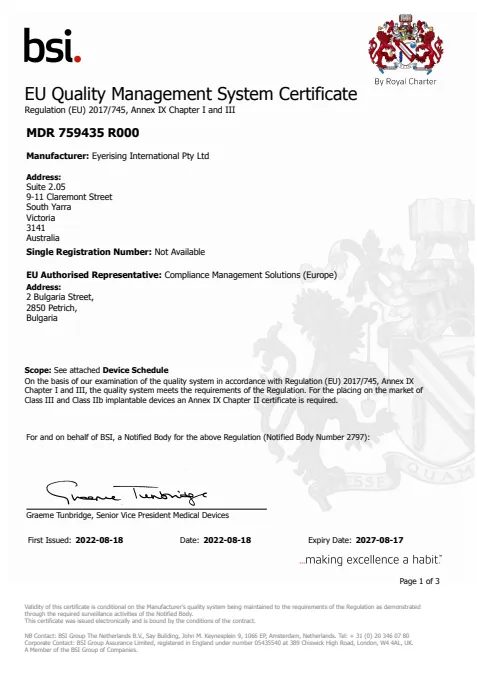
Instructions for use and manufacturer's quality management system certificate. For each file, we provide the version and scope of the document.

Instructions for use RS-200-1A · v3.1 · 18/07/2023 · EN · PDF, 2.1 MB EU QMS certificate MDR 759435 R000 · BSI 2797 · EN · PDF, 410 kB

IFU: copy provided by Euromedic Poland. Follow the instructions included with the specific device.

First page of the EU Quality Management System certificate BSI
EU QMS MDR
759435

Quality management system
Manufacturer: Eyerising International Pty Ltd

Period given in the document:
18/08/2022–17/08/2027

Device Schedule: Myopia Management Device - Class IIa. The product class is separate from laser class 3R and electrical protection class II. The QMS certificate is not a guarantee of the effect of the therapy.

Protocol, safety and organisation

  1. Team and responsibility

    Designate the doctor who will assess suitability for therapy, the team delivering it and a technical coordinator.

  2. Documentation

    Familiarise the team with the current instructions for use, the scope of the QMS certificate and the expert implementation document.

  3. Diagnostic tests and assessment

    Arrange diagnostic examinations, including AL measurement and OCT, and a formal medical decision before therapy begins.

  4. Technical commissioning

    Arrange delivery, the app, instruction and support with Euromedic Poland.

  5. Preparing the family

    Provide the therapy plan, supervision rules, medical contact and technical support contact.

  6. Monitoring and decisions

    Carry out follow-up examinations. The doctor assesses whether to continue, intensify or end therapy.

Clear division of responsibility

Doctor
Assessment for treatment, diagnostics, exclusion of contraindications and all therapeutic decisions.
Healthcare facility
Preparing diagnostic examinations, implementing the protocol after medical approval, documenting follow-up visits and educating the family.
Euromedic Poland
Delivery, setup, the app, technical instruction and technical support. Light emission settings are locked by the manufacturer at the factory.

Clinical implementation

prof. dr hab. n. med. Michał Szymon Nowak developed an expert position and methodology for clinical implementation RLRL.

An expert position and implementation document describing medical assessment of suitability for therapy, assessment of myopia progression, biometric data, safety monitoring and follow-up arrangements for clinical RLRL use.

The document concerns the implementation and monitoring of therapy in clinical practice. It is not a consensus guideline of a scientific society and does not replace individual physician assessment or instructions for use of the device.

Author: prof. dr hab. n. med. Michał Szymon Nowak
Version 1.1 · September 7, 2026 · second edition of the same document, after version 1.0.

Expert Position and Clinical Implementation Guidance for the Management of Myopia Progression in Polish Children and Adolescents

Download: RLRL-WP-PL-v1.1. Original document and version history: Zenodo, DOI 10.5281/zenodo.22698142.

Scope of the expert document

A structured pathway for controlling myopia progression in children and adolescents, from the suitability assessment to the decision to end therapy.

Assessment and biometry
The expert document describes medical assessment, axial length (AL), refraction and OCT imaging. Macular OCT is mandatory before RLRL and at scheduled structural assessments.
AL as a reference point
Serial measurements and the rate of eye elongation help assess progression and treatment response. The device’s session log does not replace clinical measurements. Regional reference charts provide context; they are not Polish diagnostic norms.
Selection of interventions - levels 0–3
The pathway includes premyopia, established myopia, progression and high myopia. RLRL is one of the interventions in the entire process. It is not a name for any red light source; the document applies to Eyerising EMMD used in accordance with IFU.
Safety and rules of conduct
Assessment for treatment, structural and functional monitoring, and discontinuation criteria set the limits of application. RLRL is not used concomitantly with atropine. Do not stop taking the medicine yourself; treatment change is determined by the doctor. Clinical symptoms are sent to the doctor, and faults are sent to technical support.
Continuation, escalation and termination
Decisions are made by the doctor. The document discusses the risk of rebound after stopping RLRL; no tapering protocol validated in a randomised trial is available for parents to use independently.
Evidence and limitations
The White Paper separates the results of randomized, observational studies and mechanistic data. It indicates the limitations of long-term data, the predominance of studies from East Asia and the lack of Polish population AL norms. The expert position is not a consensus guideline of a scientific society.

Source: RLRL-WP-PL-v1.1, 07/09/2026, chapters 3–9; expert study by prof. dr hab. n. med. Michał Szymon Nowak.

Materials tailored to you.

Choose a pathway. Parents receive a guide; professionals receive the documents needed to prepare their healthcare facility.

Preparing to introduce Eyerising at your healthcare facility? Contact Euromedic Poland about the device, documentation and technical support.

Call the distributor: +48 512 121 252

Learn more - Eyerising International ↗

Scientific evidence regarding therapy - krótkowzroczność.pl ↗

The materials you will open are in Polish (PL).

Who are the materials for?

* Required field. Telephone is optional.

Once you have entered a valid email address, it may be saved in our CRM system before the entire form is submitted to preserve your submission. Details can be found in Privacy policy .
Healthcare facility details
7–15 digits; you can add a country prefix.

You only submit contact information needed to process your request for materials. Do not provide your child's health information. Privacy Information .

Opens in a new tab.