
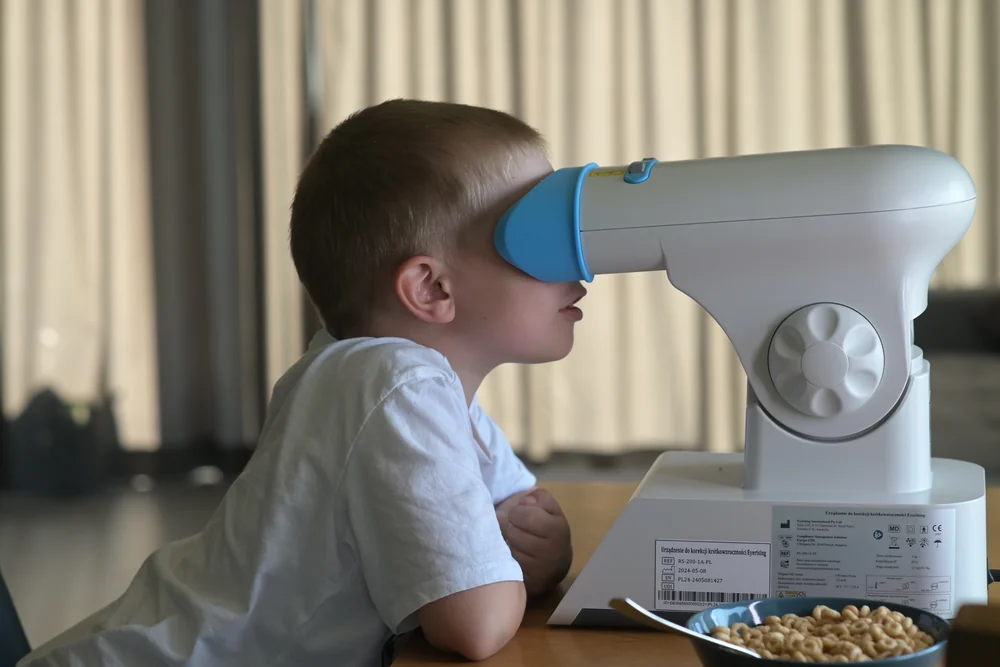
A boy next to the Eyerising device placed on the table.
Euromedic Poland · Eyerising

Eyerising RLRL device for controlling myopia progression.

Red light. Short sessions at home. For children aged 3–16, following assessment for treatment and under supervision.

3 minutes/session 2 times/day 5 days/week
RS-200-1A Device model
650 ± 10 nm Wavelength · IFU
2,1 ± 0,2 kg Device weight · IFU
EU QMS MDR 759435 · BSI 2797
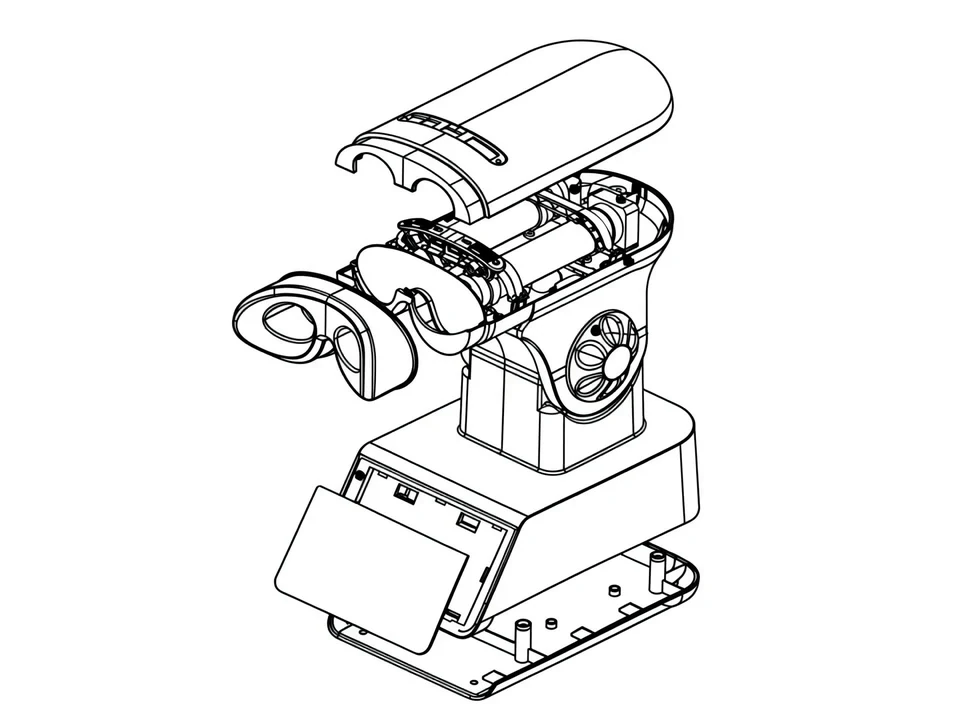
Exploded diagram of the Eyerising device: top optical assembly, body, screen and base.
01 / Anatomy of the device

Get to know each element.

From the closed housing to the construction details.

11

One device.
Eleven elements.

Scroll to unfold the device. In full view, point to or tap a number to explore the part.

Schematic diagram based on IFU, Fig. 14.

The visualization explains the structure. Do not disassemble the device. IFU v3.1, pp. 17 and 20.

All 11 items - descriptions and sources
  1. 01

    Top cover

    The outer cover of the top of the device. It is part of the optical assembly housing. The instructions do not provide for its removal by the user.

    IFU v3.1, p. 20, fig. 14; p. 17.
  2. 02

    Laser source

    Light source in the optical assembly. Emits red light: 650 ± 10 nm. The manual specifies a class 3R laser and a power of 2 ± 0.5 mW.

    IFU v3.1, pp. 19–20.
  3. 03

    Upper casing

    Housing of the upper assembly. It forms part of the structure securing the device modules. It is not intended to be disassembled by the user.

    IFU v3.1, pp. 6, 17, 20.
  4. 04

    Knob lock

    Side knob that locks the head tilt. It allows you to determine the head angle after adjusting its position to the user.

    IFU v3.1, pp. 6–7, 12–13, 20.
  5. 05

    Main bottom housing

    The lower part of the device body. Forms the casing of the lower assembly. IFU describes module mounting as a function of the housing, without separately specifying this part.

    IFU v3.1, pp. 6, 20.
  6. 06

    Base

    The bottom part of the structure. Closes the lower assembly shown in the diagram. The device should be placed on a flat table; IFU does not describe a separate base mechanism.

    IFU v3.1, pp. 10, 20.
  7. 07

    Touch screen

    Control panel on the front of the device. Used to log in, configure the connection and start the session. Shows the remaining session time.

    IFU v3.1, pp. 7, 10–14, 20.
  8. 08

    Screen housing

    Touchscreen assembly frame. It is part of the structure surrounding the screen. IFU identifies it in the drawing; it does not assign any additional utility functions to it.

    IFU v3.1, p. 20, fig. 14.
  9. 09

    Eye mask

    An element surrounding the eye area during the session. Limits ambient light from reaching the area in front of the eyes.

    IFU v3.1, pp. 6–7, 20.
  10. 10

    Window

    Optical system window, behind the eye mask. This is the place the user looks towards when setting up positions and sessions. IFU does not specify a separate shell or filter here.

    IFU v3.1, pp. 12–14, 20.
  11. 11

    The mechanism for regulating the interpupillary distance

    Mechanism for adjusting the spacing of two optical windows. It allows you to adjust the distance to the user's eyes. The setting method is described in the instructions for use.

    IFU v3.1, pp. 7, 13, 20.
A child using the Eyerising at a table, with his eyes against the mask of the device.

Use at home. Assessment and follow-up with a specialist.

02 / What is Eyerising

Technology that fits
into a daily routine.

Eyerising Myopia Management Device is a low intensity repeated exposure red light device - RLRL.

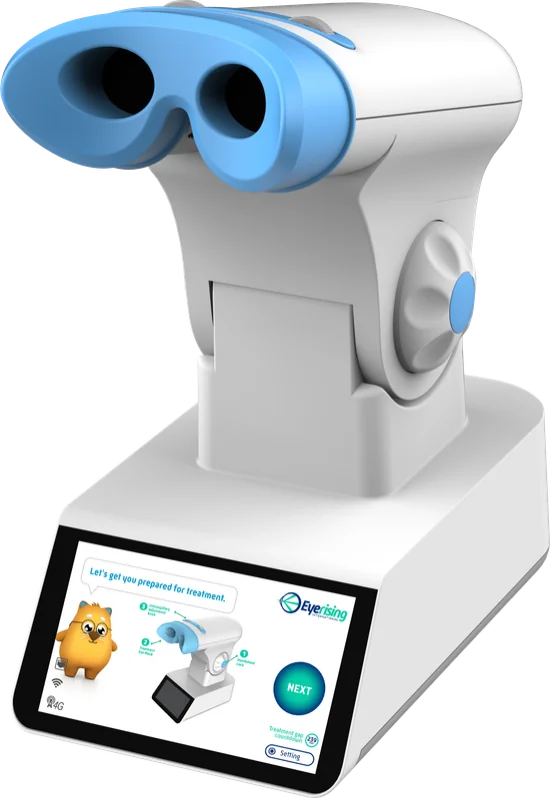
The RS-200-1A model has an optical system for two eyes, head position adjustment and a touch screen for session operation. It is intended for home use under the conditions described in the instructions.

Its purpose is to slow down the progression of myopia in children aged 3–16. Application is determined by clinical assessment for treatment; the website itself does not assess whether a child can start therapy.

Construction and technical parameters

Source: IFU RS-200-1A, v3.1, 18/07/2023 , pp. 6–9. The description does not replace the instructions supplied with the device.

03 / Treatment schedule

Short session.
Strictly defined rhythm.

Diagram from the instructions for use RS-200-1A v3.1. Do not extend or increase the number of sessions.

3 minutes

Single session time.

2 times a day

Two separate sessions per day.

5 days a week

Regular pattern with breaks.

At least 4 hours between sessions.

Maximum 10 sessions within 7 days.

IFU v3.1, p. 9.

04 / Optical system

Red light.
A defined optical system.

The semiconductor source emits light with a wavelength of 650 ± 10 nm.

Full specification

Light is supplied through two optical windows. The interpupillary distance adjustment mechanism allows you to adjust their spacing, and the side lock allows you to set the head tilt.

The manual defines the source as a class 3R laser, with a power of 2 ± 0.5 mW. Laser class, exposure dose and rules of use are part of the safety conditions.

The wavelength parameter describes light. It is not itself a promise of treatment outcome.

Source: IFU RS-200-1A, v3.1, 18/07/2023 , pp. 7, 13, 19. The description does not replace the instructions supplied with the device.

05 / First use

From preparation
until the end of the session.

The screen guides you through the operation of the device. The parent ensures proper preparation, and the specialist ensures assessment for treatment and control.

Eyerising device: front and side views
  1. Assessment and instructions

    Confirm with a specialist whether the device is suitable for your child. Read the instructions supplied with the device.

  2. A stable place

    Place the device on a flat table indoors. Connect the supplied power supply.

  3. Connection and sign-in

    Turn on the device. Configure your network connection and log in as instructed.

  4. Comfortable position

    Remove your glasses or contact lenses. Adjust the head angle and window spacing to your eyes.

  5. Three minutes of session

    Start a session on the screen. The child uses the device under the supervision of a parent or guardian.

  6. Finish and take a break

    After the session, discontinue use according to IFU. Leave at least four hours until your next session.

  7. Regular follow-up visits

    Carry out the checks established by the specialist. Report any disturbing symptoms or difficulties in operation.

Source: IFU RS-200-1A, v3.1, 18/07/2023 , pp. 10–17. The description does not replace the instructions supplied with the device.

06 / Operation and monitoring

Manage sessions on screen.
See a specialist for follow-up.

The manufacturer describes an online system for recording the use of the device and conducting sessions.

Signing in and connecting to the internet are part of the operation described in the instructions for use. A session log does not measure refractive error or the axial length of the eye.

Follow-up examinations remain the task of a specialist. Determine the scope of access to the system and the conditions for operating a specific device with Euromedic Poland before starting therapy.

Sources: IFU v3.1, pp. 10–14; manufacturer's information about the Eyerising system .

07 / Safety

Assessment is
the first step.

Know contraindications, supervision and discontinuation signals - before you start.

Not for every user

IFU lists, among others: strabismus, binocular vision abnormalities, eye diseases and dilated pupils, also after certain medications. Full details can be found on the safety page.

Read the safety rules

A disturbing symptom? Stop the session.

Persistent afterimages, visual disturbances, pain or irritation require contact with a specialist. Do not change your drug treatment yourself.

Source: IFU RS-200-1A, v3.1, 18/07/2023 , pp. 9, 16–17. The description does not replace the instructions supplied with the device.

Documentation/source files

The specifications are
documented at source.

Instructions for use and manufacturer's quality management system certificate. For each file, we provide the version and scope of the document.

Instructions for use RS-200-1A · v3.1 · 18/07/2023 · EN · PDF, 2.1 MB EU QMS certificate MDR 759435 R000 · BSI 2797 · EN · PDF, 410 kB

IFU: copy provided by Euromedic Poland. Follow the instructions included with the specific device.

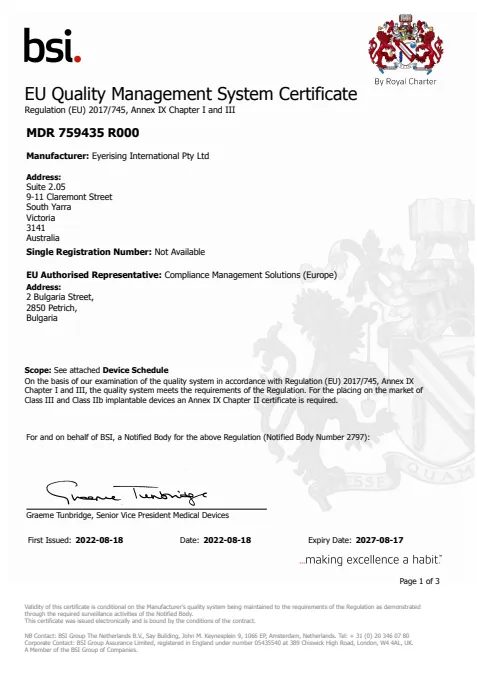
First page of the EU Quality Management System certificate BSI
EU QMS MDR
759435

Quality management system
Manufacturer: Eyerising International Pty Ltd

Period given in the document:
18/08/2022–17/08/2027

Device Schedule: Myopia Management Device - Class IIa. The product class is separate from laser class 3R and electrical protection class II. The QMS certificate is not a guarantee of the effect of the therapy.

Selected source publications

We present three introductory publications: a clinical trial, an observation of the durability of the effect and a safety review.

Bibliographic verification: PubMed and DOI, 15/09/2026. The summary is neither a systematic review of all publications nor a clinical recommendation.

Clinical effectiveness

Effect of Repeated Low-Level Red-Light Therapy for Myopia Control in Children: A Multicenter Randomized Controlled Trial.

Ophthalmology · 2022 · Multicenter, randomized, parallel, single-blind clinical trial

Authors: Yu Jiang; Zhuoting Zhu; Xingping Tan; Xiangbin Kong; Hui Zhong; Jian Zhang; Ruilin Xiong; Yixiong Yuan; Junwen Zeng; Ian G Morgan; Mingguang He

What was tested: The change in eye axial length and refraction with RLRL was compared with standard single vision glasses.

Details of the study
Population
264 eligible Chinese children aged 8–13 years; 246 children were included in the analysis.
Methodology
RLRL with single vision glasses was compared with glasses alone; observation lasted 12 months.
The most important result
In the analysis, the authors reported less axial elongation and less refractive progression in the RLRL group than in the control group.
Safety
There were no serious adverse events, functional visual loss, or structural changes in OCT during the follow-up period.
Constraints and context
The study was single-blind, focused on Chinese children and had one described system; observation lasted for a year.
Tested device/system
Tested system: Eyerising, Suzhou Xuanjia Optoelectronics Technology, 650 ± 10 nm. The publication describes a class IIa medical device according to China NMPA (registration no. 170808-01039) and, separately, optical exposure class 1 according to IEC 60825-1:2014.
The publication does not allow automatic identification of the tested device with the RS-200-1A model currently offered in Poland.
Funding and declared conflicts of interest
This study was supported by the Fundamental Research Funds of the State Key Laboratory of Ophthalmology and the National Natural Science Foundation of China (81420108008, 81271037). Zhuoting Zhu and Mingguang He have declared patent CN201910490186.6 related to the study.

Identifiers: Ophthalmology 2022; 129(5): 509–519. PMID 34863776.

Myopia Control Effect of Repeated Low-Level Red-Light Therapy in Chinese Children: A Randomized, Double-Blind, Controlled Clinical Trial.

Ophthalmology · 2023 · Randomized, double-blind, controlled clinical trial

Authors: Jing Dong; Zhuoting Zhu; Haifeng Xu; Mingguang He

What was tested: RLRL was evaluated against a sham device with 10% power of the active device.

Details of the study
Population
112 Chinese children aged 7–12 with myopia; 111 children were included in the analysis.
Methodology
Sessions lasted 3 minutes and took place twice daily, at least 4 hours apart; follow-up assessment was performed at 6 months.
The most important result
The authors reported less refractive progression and axial lengthening in the RLRL group than in the sham device group.
Safety
No treatment-related adverse events were reported in the abstract.
Constraints and context
The observation lasted 6 months and concerned one geographical population and the described RLRL system.
Tested device/system
Active and mock system tested: Eyerising, Suzhou Xuanjia Optoelectronics Technology; the sham device emitted 10% of the power of the active device.
The publication does not allow automatic identification of the tested device with the RS-200-1A model currently offered in Poland.
Funding and declared conflicts of interest
The study was supported by the Fundamental Research Funds of the State Key Laboratory of Ophthalmology (303060202400362) and Eyerising Ltd.; the sponsors had no involvement in the design or conduct of the study. Zhuoting Zhu declared patent CN201910490186.6, and Mingguang He declared board membership and ownership interest in Eyerising Ltd. and Eyerising International Pty Ltd. and this patent.

Identifiers: Ophthalmology 2023; 130(2): 198–204. PMID 36049646.

Durability of effect and rebound

Sustained and rebound effect of repeated low-level red-light therapy on myopia control: A 2-year post-trial follow-up study.

Clinical and Experimental Ophthalmology · 2022 · Two-year follow-up after completion of a previous randomized trial

Authors: Ruilin Xiong; Zhuoting Zhu; Yu Jiang; Xiangbin Kong; Jian Zhang; Wei Wang; Katerina Kiburg; Yixiong Yuan; Yanping Chen; Shiran Zhang; Meng Xuan; Junwen Zeng; Ian G Morgan; Mingguang He

What was tested: The continuation of the effect of RLRL and the change after discontinuation of use were assessed.

Details of the study
Population
Of 199 eligible Chinese children, 114 participants were included in the analysis; some continued RLRL and some ended them.
Methodology
Four groups were compared depending on the continuation or termination of RLRL and the use of single vision glasses.
The most important result
The authors reported the smallest two-year changes in AL and SER in the group continuing RLRL and minor rebound after completion.
Safety
There were no reported adverse events or functional or structural damage reported in the abstract.
Constraints and context
This is a post-study follow-up: participants were not randomly assigned to continue or terminate in the second year, and the percentage analyzed was limited.
Tested device/system
Tested system: Eyerising, Suzhou Xuanjia Optoelectronics Technology, home stationary device emitting red light 650 ± 10 nm.
The publication does not allow automatic identification of the tested device with the RS-200-1A model currently offered in Poland.
Funding and declared conflicts of interest
Not clearly established based on the available record.

Identifiers: Clinical and Experimental Ophthalmology 2022; 50(9): 1013–1024. PMID 36054314.

Go to the full bibliography for specialists

Two perspectives / one device

For the parent.

Intended use, daily operation and safety rules in one place.

Where to start
Euromedic Poland

Polish contact
regarding Eyerising.

Information about the device, therapy conditions, documents and operation.

The manufacturer of the device is Eyerising International Pty Ltd from Australia. The main and only distributor in Poland is Euromedic Poland.

Data and contact
Euromedic Poland
Euromedic Poland Sp. z o.o.
Łódź, Poland
NIP 7252362338
KRS 0001212112
Price and conditions of therapy

Know the conditions.
Make an informed decision.

Starting therapy requires assessment for treatment by a specialist.

Find out the price and conditions of red light therapy.

You agree on the assessment for treatment and follow-up visit plan with a specialist. For organizational matters, please contact Euromedic Poland.

Ask about therapy
Let's talk about therapy

Specific questions.
Direct contact.

Therapy conditions, documentation and operation of the device.

+48 512 121 252

Monday–Friday, 9:00–17:00

Materials tailored to you.

Choose a pathway. Parents receive a guide; professionals receive the documents needed to prepare their healthcare facility.

Please ask your doctor if you have any questions about your child's health. Euromedic is responsible for the device, technical implementation and technical support.

Find a facility and medical contact ↗

For technical matters: +48 512 121 252

Check the scientific evidence for the therapy ↗

The materials you will open are in Polish (PL).

Who are the materials for?

* Required field. Telephone is optional.

Once you have entered a valid email address, it may be saved in our CRM system before the entire form is submitted to preserve your submission. Details can be found in Privacy policy .
7–15 digits; you can add a country prefix.

You only submit contact information needed to process your request for materials. Do not provide your child's health information. Privacy Information .

Opens in a new tab.